
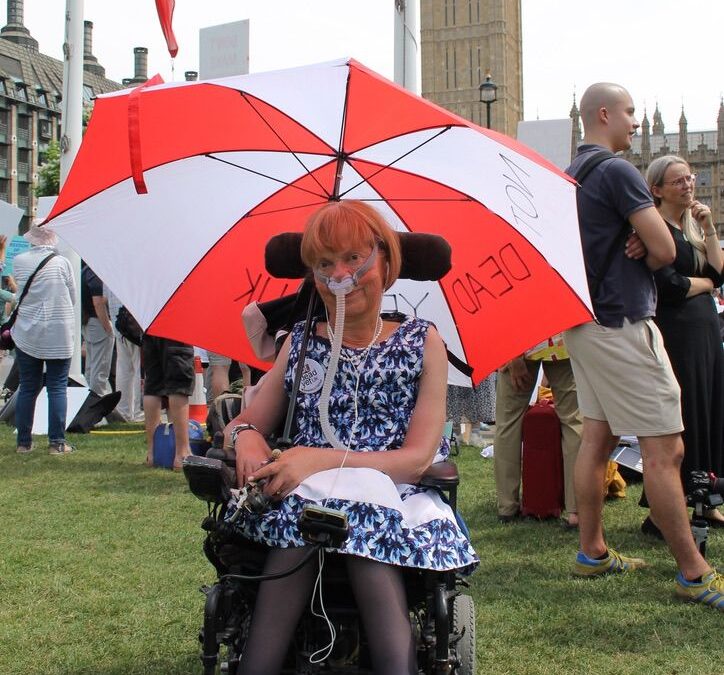
Why Only Once a Year!
Baroness Campbell of Surbiton
International Women’s Day gives us the opportunity to celebrate women’s achievements across the world and their contribution to society. Today, I want to focus with pride on disabled women, whose leadership and talent have reshaped our understanding of equality and inclusion — and then contrast that with what happens when disabled women are ignored.
Modern disabled women refuse to be defined by diagnosis. They define themselves by determination, skill and leadership. They are clear that their lives are not exceptional — they are entirely natural when barriers are removed.
Para-Olympians are probably the best known for changing society’s perceptions of disability. Figures such as Baroness Tanni Grey-Thompson being the earliest and best known sportswomen to radically transform expectations. When she began her career, she faced not just competitors but profound barriers of access and attitude. Through sheer force of will — and 11 gold medals — she fought for the right inclusive conditions so others could follow.
Today, Sarah Storey holds more Paralympic gold medals than any other British female Paralympian in history. Like her predecessor, she has ensured that her success is about more than medals. She has demonstrated that motherhood, disability and elite athletic performance are not contradictions but coexist powerfully in one woman.
Achievement is not confined to stadiums. In the arts, Liz Carr, an Olivier Award-winning actress, has challenged stereotypes with intelligence and wit. Through her performances and activism, she has confronted harmful narratives about assisted dying and the value placed on disabled lives. She has used visibility not for celebrity, but for advocacy.
Similarly, Rose Ayling-Ellis brought British Sign Language into millions of homes during Strictly Come Dancing, when over 11 million viewers watched her silent tribute to the deaf community. She broke stereotypes, achieved the earliest perfect score of 40, and sparked a surge of interest in BSL. She then used that platform to support older deaf residents in care homes, demonstrating that when communication barriers fall, everyone benefits.
In a society obsessed with physical perfection, disabled women and girls often face online abuse, low self-esteem and sometimes hate crime. Katie Piper, OBE, survived a life-changing acid attack and has since become a powerful advocate for burn survivors and those with visible differences. Through her foundation, she challenges society’s fixation on appearance and demonstrates that to be different is to be beautiful.
But for every socially included disabled woman we celebrate, there are hundreds whose independence is denied and whose potential is ignored.
Which brings me to Lucinda Ritchie aged 33 with everything to live for. She is academically accomplished and nationally recognised for her assistive technology advocacy. She graduated with first-class honours and is studying for a master’s degree in sustainability She uses a powered wheelchair, breathes with a ventilator and communicates through eye-gaze technology..
She was living in her adapted bungalow with 24-hour one to one health care personal assistants. She was thriving and independent. After a hospital admission with severe pneumonia last April, she finally expected to return home fit to continue her life last month.
Instead, her local authority local NHS care board [NHS Sussex] decided it was “in her best interests and safer” to place her in a nursing home miles from home. Overstretched staff, unfamiliar with her complex needs, switched off her power chair and couldn’t properly set up her eye gaze computer. A woman who had been thriving is now isolated and frightened and worse, back in hospital because the care provided was not good enough to keep her well. This decision runs counter to her Article 19 rights to live independently.
For decades, personal budgets and empowerment models transformed disabled people’s lives, enabling them to engage personal assistants and exercise genuine choice and control. Independent living is not theoretical; it is deliverable.
So it begs the question: where has that good practice gone? Why did we support disabled people to move out of institutions only to return them 25 years later? Guidance, regulation and legislation exist. If properly enacted, they empower people like Lucinda to thrive.
Last week Lucinda said she feels “betrayed, worthless and frightened,” and her life won’t be worth living if she cannot return home.
I invite all members of Parliament to ask themselves why are women like Lucinda not celebrated for their achievements on International Women’s Day? And why am I the only one? We should note their presence and contribution more than once a year. Disabled women’s right to equality, dignity and freedom is not symbolic. It is vital — and it must be upheld not just today, but every day of the year.
Recent Comments